Leonardo's Mona Lisa and Giorgionne's The Tempest

Art is the pinnacle expression of human emotion, and by studying art, humanity can understand both themselves and the past. Eras of art history directly represent distinct paradigm shifts in the overall view of the world. One of the greatest examples of artworks representing a radical worldview change is within the Renaissance. Specifically in Europe, the transition from the Medieval era’s emphasis on religious faith and the fear of sin towards Renaissance humanism and scientific exploration was portrayed in the art produced at this time as well. Leonardo da Vinci’s Mona Lisa and Giorgionne’s The Tempest both represent the ideals of the Renaissance and influenced future artists to continue expressing Renaissance principles.

Mona Lisa is one of the most recognized symbols of the Renaissance, not only due to Leonardo’s immense skill but also because of its impact on portraiture. Although the sitter of the Mona Lisa is not confirmed by art historians, it is widely acknowledged to be a portrait of Lisa del Giocondo, wife of patron Francesco del Giocondo (Zöllner, Leonardo Da Vinci 154). Despite a lack of direct documentation, Mona Lisa was most likely commissioned to commemorate the birth of Lisa and Francesco’s third son in December 1502 or the purchase of a new house (Zöllner, Leonardo’s Portrait 122). Familial events were common themes in 15th and 16th century patronage, so either of these theories would fit the practices of the era.
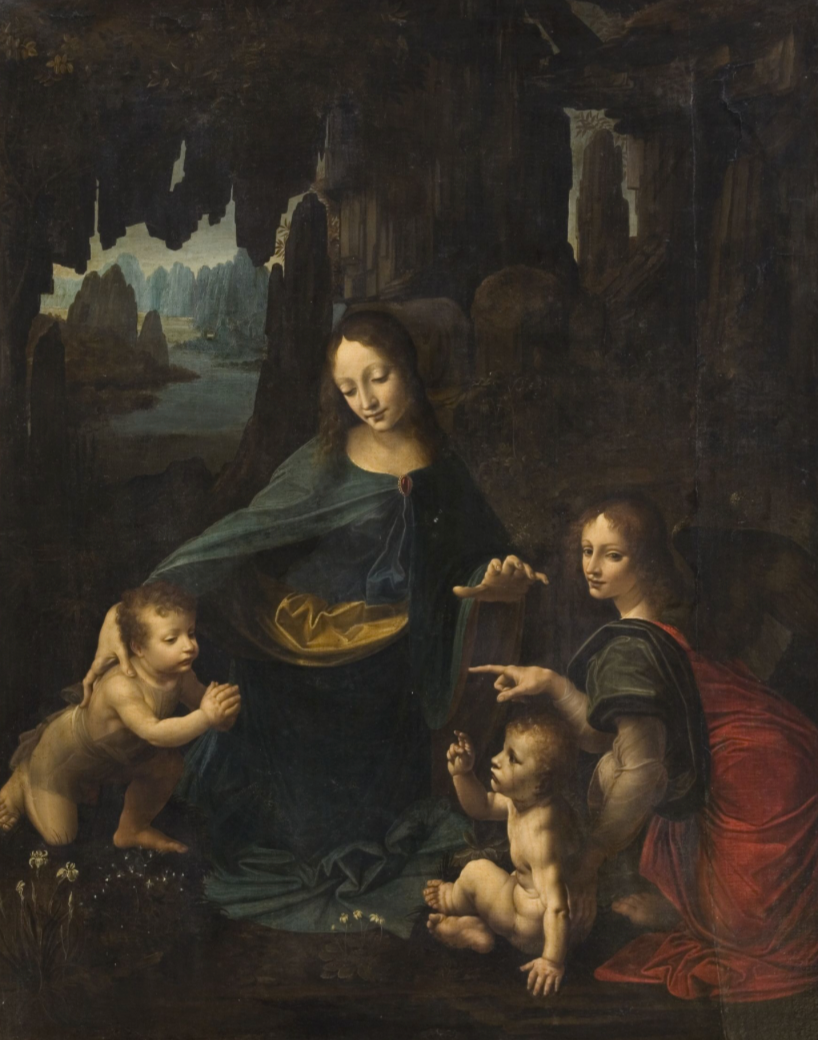
The naming of the Mona Lisa is also quite significant; “Mona” or “Madonna” is a direct reference to the Virgin Mary. During the 15th and 16th centuries in Europe, Christianity was still a prominent aspect of many lives. Women were expected to live their lives with the same morality as the Virgin Mary (Zöllner, Leonardo’s Portrait 125). Although Mona Lisa is a secular piece, it draws heavy inspirations from previous portrayals of the Virgin Mary in order to reference the moral expectations of women at the time. Portraits of the Madonna, such as Lippi’s Madonna and Child, show great visual similarities to Mona Lisa like the outdoor landscape and content expression. In the background of Mona Lisa, Leonardo paints jagged rocks that have a striking resemblance to the setting of another one of his paintings: The Virgin of the Rocks.

The setting of the Mona Lisa also draws great significance, as the landscape evokes emotion. A hazy atmospheric perspective was heavily utilized in the outdoor landscape, with the ambiguous rocks and a curved path behind the Mona Lisa. The hazy background corresponds well with the distinct sfumato shown in her skin and hair. Additionally, Mona Lisa’s eyes are famous for following the viewer no matter what angle they are at. Placing the sitter at a three-quarter angle allows this eye contact to take place; previous 15th century portraiture was done impersonally in a strict profile shown by Ghirlandajo’s Portrait of Giovanna degli Albizzi. Mona Lisa's eye contact promotes intimacy between the viewer and the sitter, creating a deep emotional connection with the piece.

The emphasis on the emotion of an artwork is indicative of the Renaissance, as it allows the viewer to interact with the piece. The Renaissance places a focus on individual thought, and viewer interaction promotes their thinking about a piece. Giorgionne heavily evokes both emotion and thought in his piece, The Tempest, through its landscape and ambiguity.

Similar to Mona Lisa, The Tempest’s subject matter is unclear due to lack of documentation, but art historians have many theories. One of the current theories is that The Tempest is a martial allegory painted for Gabriele Vendramin to commemorate his uncle and brothers’ involvement in the Cambrai Wars. This was theorized due to the broken columns on the left signifying battle and the nursing mother on the right symbolizing charity (Paoletti 355). Others view The Tempest as a Biblical or mythological representation. However, the subject of the painting is not as important as the feeling it evokes in the viewer.
By moving the two figures (a clothed man and the nursing woman) to the sides of the painting, the central figure of The Tempest is the landscape: the lightning appearing in the distant clouds over a seemingly Medieval city. This landscape creates the mood of the feeling right before a storm. Through the soft, feathery leaves, moist landscape, and sparkling highlights, Giorgionne creates a romantic poesia (a painting meant to operate in the indirect manner of poetry) for the viewer to interpret themselves (Lettieri 66). The woman is also looking directly at the viewer, creating a similar intimacy as the Mona Lisa.
Mona Lisa and The Tempest both emphasize the importance of individual thought through their interactive nature. By highlighting landscape and secular ideals, both of these pieces represented the shift toward humanism during the Renaissance.
Works Cited
Artist: Filippino Lippi (Italian, Prato ca. 1457–1504 Florence). Madonna and Child. Madonna and Child [49.7.10], ca. 1483–84, The Metropolitan Museum of Art. JSTOR, https://jstor.org/stable/community.18476540. Tempera, oil, and gold on wood. Accessed 15 May 2026.
Dissanayake, Ellen. What is art for?. University of Washington Press, 2015.
Lettieri, Dan. “Landscape and Lyricism in Giorgione’s ‘Tempesta.’” Artibus et Historiae, vol. 15, no. 30, 1994, pp. 55–70. JSTOR, https://doi.org/10.2307/1483473. Accessed 4 May 2026.
Leonardo da Vinci, and kopi efter: Leonardo da Vinci. Madonna i Klippegrotten; The Virgin of the Rocks. 1601-1700, <a href="https://www.smk.dk/en/">Statens Museum for Kunst</a>. JSTOR, https://jstor.org/stable/community.28361092. Lærred; olie; Olie på lærred; Oil on canvas. Accessed 15 May 2026.
Neurdein et Cie (ND Phot.) (publisher, French, act. 1860’s-1919), and artwork depicted by Leonardo da Vinci (painter, Italian, 1452-1519). Musee Du Louvre -- Ecole Florentine -- VINCI (Lionardo Da), Dit Leonard de Vinci (1452-1519). La Joconde [Louvre Museum -- Florentine School. Vinci (Leonardo Da), Called Leonardo Da Vinci (1452-1519). The Mona Lisa]. ND Phot. 1009; Verso: [Divided Back, No Message]. ca.1907-1914 (publication date), Trinity College, Watkinson Library (Hartford, Connecticut, USA). Watkinson Library Special Collections. Trinity College Digital Repository. JSTOR, https://jstor.org/stable/community.3244846. Cardstock; paper. Accessed 15 May 2026.
Paoletti, John T., and Gary M. Radke. Art in Renaissance Italy. Laurence King, 2024.
Zöllner, F. Leonardo's portrait of Mona Lisa del Giocondo. Gazette des Beaux-arts, 1993, pp. 121, 115-138.
Zöllner, Frank. “VII From Mantua To Venice and Back to Florence 1500-1503.” Leonardo Da Vinci: The Complete Paintings and Drawings, 2003, pp. 154–161.


Comments